‘We are changing things for working-class women’
Clare Mulligan-Foster started work at 16 but knew she wanted more than the nine-to-five. She shares a story of curiosity and experimentation, courage and confidence, to forge a portfolio career.

When Clare Mulligan-Foster was two, her parents relocated with their six children from Belfast to Manchester. In the early 1970s, during a particularly intense period of conflict in Northern Ireland, Clare’s mother and father picked up everything they could carry and got on a ferry to Liverpool. They wanted the family to feel safe, so they had to start again.
The Mulligans set up home in Urmston, a town in Trafford, southwest of the city centre. They were a working-class family, living alongside others employed at the nearby industrial area Trafford Park and in the city. Clare’s father was a milkman and would always have two or three jobs. Her mum was the same, but her main focus was looking after Clare and her brothers and sisters.
Clare remembers a fun upbringing, rooted in her family and the local community. As the youngest of six, there was always someone to play with and new friends to make. She describes her family as optimistic people who looked at the positives and embraced life as it came to them. At school, the siblings did well, but they weren’t the type of family to go to university. Everyone left education at 16 and got a job.
Like most people of that age, Clare scoured the classified ads in the Manchester Evening News looking for work. At the time, The Co-operative Insurance Society (CIS) was recruiting, and she applied. During the interview, her new employer, said: ‘you did well in your maths, so we’ll put you in the actuarial department.’ She didn’t know what that meant but says she was “delighted”.
Early on in her career, Clare remembers getting on the bus to work, with her friends. There were people on board like her, starting out in their careers, but also those in their thirties and forties (who looked much older to her, at that time). They would carry their packed lunches and books to read on the journey; the same routine, day in, day out.
“I remember thinking: I don’t want to do that; I don’t want to be commuting into the city centre when I am older,” says Clare. “I had no idea what another job looked like, but I just knew I didn’t want to travel like that. This would have been about 1990. That was the seed from which everything else grew.”
A curiosity for learning
It took Clare 12 years to do something about the feeling she had on the bus that day because the world was a different place in the 1990s. She didn’t have access to people starting businesses, or social media promoting freelance work, or any alternative to what she was doing. She doesn’t remember other women running businesses; if they were, then it was working as a hairdresser or a running a local café. Her network was small and full of people from similar backgrounds.
But the seed had been planted and it was slowly flourishing. As Clare worked her way up at CIS, she launched pension schemes, ran customer services teams and IT projects. She enjoyed the rhythms of work: the people, the activities and the challenges; but less so the corporate environment. She also started going to night school: a GCSE in psychology, computer classes, interior design, Spanish; it didn’t matter what the topic was, the key was a curiosity for learning. Every year, she did something new.
By the age of 29, with her experience building, a switch flicked in her mind and Clare quit her job in Manchester. She wanted to explore her options; to go somewhere else and be somebody else. As an adult, she moved back across the Irish Sea, to Dublin. Another job in the pensions industry followed, alongside conversations with a careers counsellor. She loved working with people, but didn’t want to work in HR; she enjoyed big projects, but didn’t want to do IT. So, she asked the counsellor about his role. ‘I’m an occupational psychologist,’ he replied. Clare told him she’d never heard of it. Once he explained, she realised that this was the career for her, too. “It fitted in the gap between HR and project work I had been looking for, and gave me an identity that would support a move to self-employment,” she says.
The prospect of four years at university to study for a psychology degree was off putting, at first, but Clare soon realised the time would pass anyway. So, she enrolled at Dublin Business School during the evenings. In 2008, realising that professional skills in sales, marketing and leadership would help her in the future, she met with a local recruiter about her predicament, who knew someone who was looking to launch a new pensions business from scratch. At 8am the next morning, Clare was having a coffee with a local entrepreneur, and by 8.20am, he offered her a job. They had an empty floor of a building, but not much else. But, together, they set up a new pensions company in Dublin and expanded into London.
Clare lights up when she talks about these years in her career. A new business, a blank slate; it was the start of something that would help her to take the next step towards self-employment and being her own boss. She also studied for a master’s degree in work and organisational psychology at Dublin City University. She remembers going for an interview, meeting the course leader, who would later become a mentor, and begging to be let on the course. They laughed about it later – she would have been allowed to enroll anyway – but her persistence and sense of direction was evident.
During her studies, Clare turned 40, and another switch flicked in her mind. She resigned from her job, again. Her family thought she was mad; they started what Clare calls ‘interventions’. But she had changed, and her network had changed; the people on her course were psychologists and consultants. And, in the same way she had left her job at CIS, it was another quick decision. Soon after, she set up her business on the kitchen table.
“I felt like a kid in a sweet shop,” she says. “But for the first year, I hardly earned a bean. That was the biggest shock, going from being the managing director of a company where people would answer the phone, or call you back. People didn’t answer phones to the self-employed. I thought it would be easier to get work.
“I heard a lovely phrase recently, ‘career angels’, people who saw more in me than I did, or encouraged me, or opened doors,” she adds. “The person who interviewed me for my master’s became one of those people. She gave me good advice, put my name forward for things and told me to speak at events and write. Ireland is like a village. It took two or three years, but then I was flying.”
A portfolio career
Clare returned to the UK in 2016. In the past ten years, she has re-built her consulting business and expanded her work with universities. I met her in Manchester soon after she came back from Ireland, and was struck by her professional philosophy, shunning full-time employment for several different jobs and projects: lecturing on leadership and psychology at universities, running workshops for corporates, and, more recently, developing her coaching and supervision practice. If you look at her profile on LinkedIn, you can see these professional layers, building and developing.
Her approach has also opened doors. During a professional doctorate at Birkbeck, University of London, Clare researched mid-life career changes for people over 50; shining a light on everything she had been through to help others do the same thing. She’s always talked passionately about ‘second-curve careers’, but now had a chance to understand them in depth, to coach others through the process, and to share her research more widely. In the past year, she has been commissioned to write a book about it, which comes out later in 2026.
“When I was studying for my master’s, I read about Charles Handy, who talked about the future of organisations,” says Clare. “He said we couldn’t rely on them to be around forever due to technology changes and talked about people creating their own careers; he coined the phrase ‘portfolio career’. Charles and his wife had a one between them; she was a photographer, and he worked in consultancy, after a career at Shell. For six months of the year, they would focus on her business, and then for six months of the year, on his.”
Navigating transitions
I ask Clare about leading ourselves through the transition from full-time working to portfolio, freelance, or self-employment. Because it’s not straightforward. She suggests that people often know they want to do something else but haven’t had the space to think it through. They hit a brick wall because they can’t see, or feel, what it might look like. And there is usually fear; fear around the loss of identity, the loss of pay; for those in their 50s, closer to retirement, these factors can be heightened.
But the process of exploring the transition begins to open doors in their minds. And it starts more simply than I expected. Every single person she interviewed for her doctorate research – there were 15 in-depth conversations – wanted more time to do other things. Not big ideas about business, but simple ideas about their personal life: to enjoy walking their dog, for example. If people know what they want from their lives, and how their careers can support that, then they can start to find the answers.
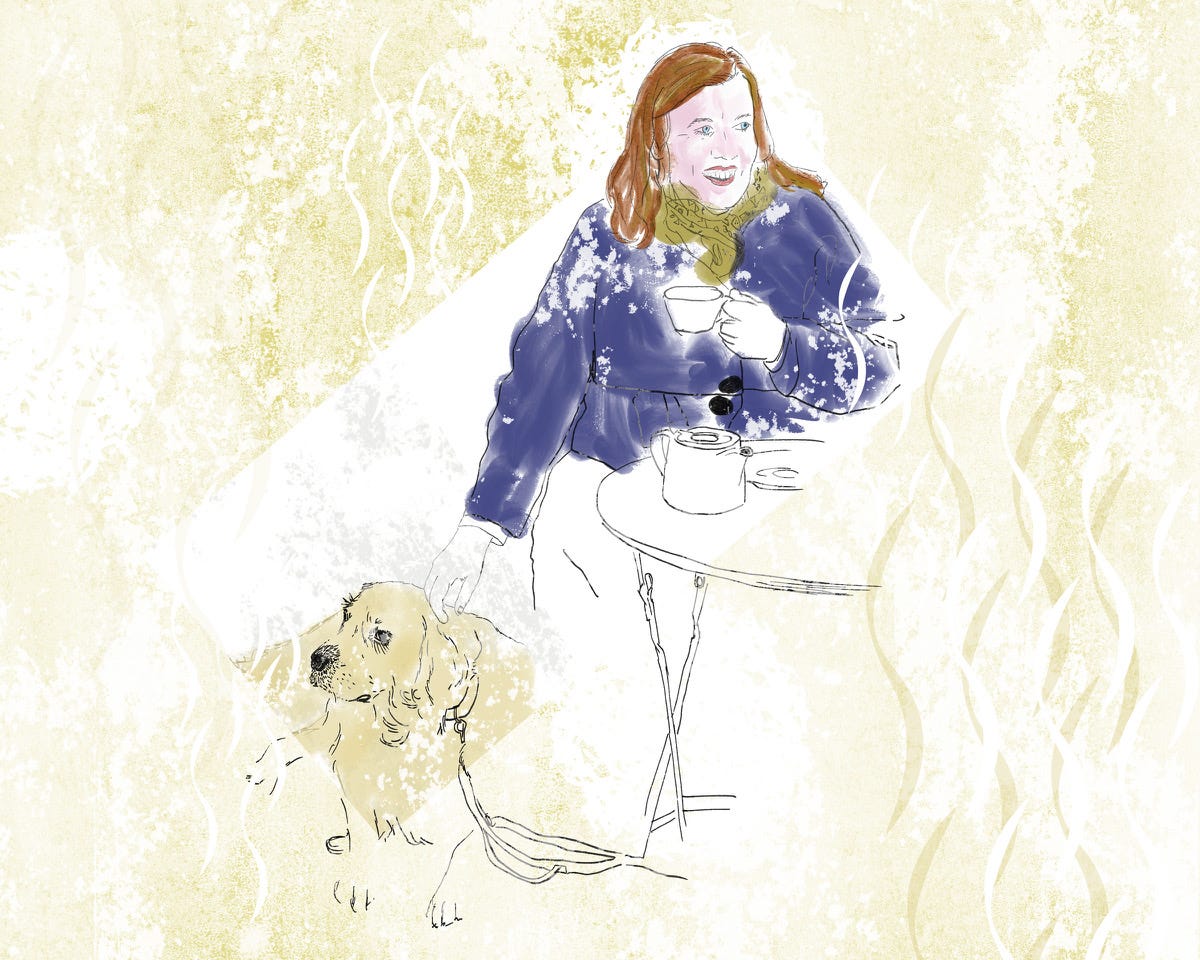
“For years, I was getting buses, planes and trains and having to be somewhere at a particular time,” she says. “But I love a mug of tea. That’s the Irish in me; we solve everything over a mug of tea. So, what I wanted was very simple; to make a mug of tea and drink it without having to rush to be somewhere. I realised this was part of my portfolio. So, I walk my dog, have a mug of tea, and I don’t start work until ten. This morning routine is joyful to me, and really quite simple.”
The transition is also about identity, experimentation and values. We all possess multiple identities; at work, at home, through our hobbies, and each of those will be important in different ways. But the biggest transition is often the loss of identity associated with leaving a high-profile role. As Clare found, being the managing director of a business one day to being self-employed the next, carries a sense of loss. It’s easier if we have a professional identity of some kind – she calls herself an occupational psychologist – which can exist independently of any employer. So does our experience, but it doesn’t always feel like that.
Then it’s time to ask questions: What does the next three to five years look like? Where would you like to be working? Where would you like to be living? How can your financial goals be met? As you do this, different themes will come up and Clare advises noticing when you feel something: joy, excitement, stress – they all help to show the way forward. Some decisions invite a quick ‘yes’; otherwise, work it through and talk to someone. The big lesson here is that transition is a door; a door through which you can explore what matters, what’s possible, and what’s holding you back. You can assess your values, identities, and you can experiment. Once a door begins to open, you can see more, so it’s important to stay curious and flexible.
“Boundaries are important,” she adds. “If you don’t plan it for yourself, other people will make decisions for you; and if you aren’t clear about what you want to do, then you might end up following other people’s advice. Boundaries allow safe exploration, and a trusted network supports you when it feels wobbly.
“We all have expertise in what we should be doing,” she says. “There are those who work in companies who have advice for self-employed people, but they would never do it themselves. There can be fear around giving up that regular pay cheque and fear of the future. But there is joy because you are working in a way that you want to.”
I ask Clare about what’s next. She is now in her 50s, having achieved what she set out to do. But because she has created a working life she loves – she’s just started lecturing at the University of Chester, a ten-minute walk from home – there isn’t any reason to change, or to ‘get out’. “I love being a psychologist,” she says. “When people ask me the best thing about getting a doctorate, I say that my mum can tell everyone that her daughter is a doctor. They all laugh, but for her, there is pride in the fact we are changing career and education paths for working-class women.”